Key West Can't Build You a New Dock. Here's Why That Matters More Than the View.
September 17, 2026
September 17, 2026
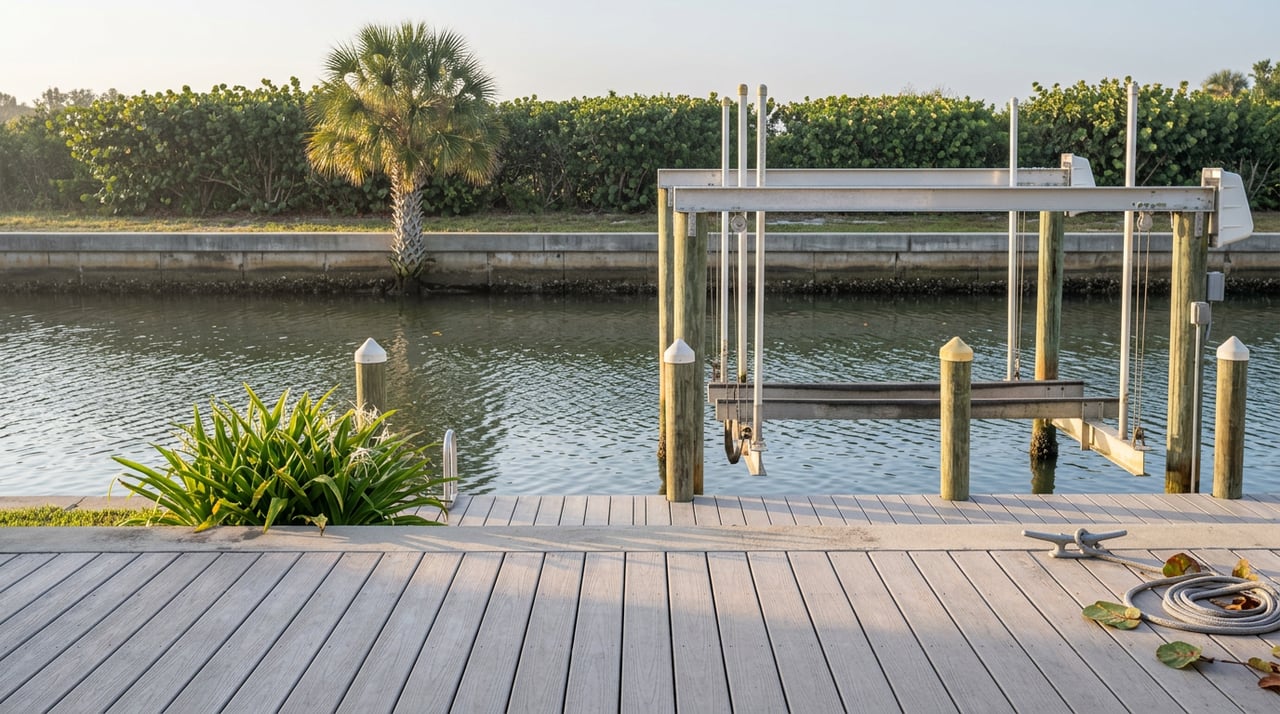
A canal-front listing in Key West photographs like every other canal-front listing. Turquoise water, a seawall, maybe a boat already tied up for staging. What the photos don't show is the paperwork behind the dock, and that paperwork is where a surprising number of Key West waterfront contracts run into trouble.
Buyers who have shopped waterfront elsewhere in Florida tend to assume dockage is something you build to fit your boat. Want a bigger slip, a second lift, or a deeper cut into the canal? Hire a marine contractor and get in line for permits. In the Lower Keys, that assumption is wrong in a specific and consequential way, and understanding why changes how you should read a listing here.
Owning waterfront property in Florida gives you riparian rights, not ownership of the water itself. You get reasonable access, the ability to build a dock, and a boundary that runs to the mean high-water line. The state holds everything below that line in trust for the public, which is why every dock, lift, and seawall repair in the Keys runs through a permitting process before a contractor ever touches the water.
For most of Florida, that process is a matter of paperwork and patience. In the Florida Keys it runs into a harder limit. Florida Administrative Code 18-21.0041, the rule governing marina and dock siting on state-owned submerged land, puts a standing moratorium on approving new leases for multi-slip docking facilities anywhere from Tea Table Channel north through the Monroe County line. The same rule separately bars dredging or filling to create new canal or channel access, and extends that restriction to widening or deepening any existing canal, with an exception carved out only for regular maintenance dredging that doesn't exceed depths already established.
Read plainly, that means the private and semi-private dockage that already exists along Key West's canals is close to the last of its kind. Nobody is cutting a new canal into the rock to create the next Riviera Drive. Nobody is deepening an existing canal to fit a bigger sportfisher. What's docked today is what the geography and the paperwork will allow tomorrow.
As of mid-September 2026, there were 121 waterfront homes listed for sale in Key West, with a median list price near $1.27 million and a median time on market of 124 days. Those numbers describe a market, but they don't explain themselves. The explanation is the supply story above: canal-front homes with existing, permitted dockage are the liquid end of Key West's waterfront market precisely because that dockage cannot be recreated elsewhere. A buyer who wants private access to open water without inheriting the maintenance and insurance profile of a true oceanfront lot has a narrow, fixed set of properties to choose from, and that scarcity shapes how quickly the right listing moves.
| Canal-front | Bay or backcountry | Open water / oceanfront | |
|---|---|---|---|
| Typical dockage | Private, often with existing lift | Private or shared, variable depth | Less common, more exposed to wind and swell |
| Protection from weather | Highest, sheltered by adjacent lots | Moderate | Lowest, direct exposure |
| New dockage available | No, capacity fixed by existing permits | Limited, same moratorium applies | Rare, site-dependent |
The table isn't a ranking. It's a reminder that "waterfront" in Key West covers three different ownership experiences, and the one constant across all three is that none of them can grow their own dock capacity on demand.
Even where a dock already exists, adding a boat lift isn't automatically simple. Key West sits on limestone, and conventional cradle-style lifts depend on driving pilings into the bottom to support the structure. That's routine on a sandy canal bottom in much of Florida. It's often not an option here. One boat lift installer serving the area puts it directly: "Boat elevators are perfect for areas such as Key West where pilings needed for cradle boat lifts can't be built."
That's a real design constraint, not a sales pitch. A buyer who assumes they'll simply add a standard lift after closing may find the site dictates a different, pricier category of equipment. A national pricing overview published in March 2026 put residential boat lifts in a broad range from roughly $2,500 to $35,000 or more before installation, with installation itself adding another $500 to $5,000. Those figures aren't Key West-specific, but they establish the baseline a buyer should expect to clear before assuming the more complex, foundation-free systems that limestone sites sometimes require.
The scarcity isn't limited to private lots. Garrison Bight Marina, the only full-service marina on the island of Key West, operates roughly 20 wet slips and 213 dry slips, and it's the island's only dry-stack operation. A short distance away, the city-run marina at Garrison Bight has 245 slips straddling the Palm Avenue causeway, home to the Key West Historic Charter Boat Row. Just north of it, the Garrison Bight Mooring Field started with 81 moorings and grew to 149 only through a grant from Monroe County's Department of Marine Resources, not through routine expansion.
Even public dockage in Key West grows in small, negotiated increments rather than scaling up to meet demand. If the city's own marina infrastructure expands one grant at a time, it should be no surprise that private canal dockage, frozen by state rule since the multi-slip moratorium took hold, isn't going to loosen up for an individual buyer either.
Not every canal in Key West offers the same functional access, and this is where the moratorium's logic gets personal for a buyer. The Riviera Canal is one of the few on the island marketed for direct, uninterrupted boating access rather than a route that winds past bridges or shallow cuts. On Stock Island, a pair of adjoining lots on 12th Avenue combine for 80 feet of canal frontage and are positioned on one of the deepest canals in the 33040 zip code.
Both examples point to the same underlying fact. Because no new dredging is coming and no canal will be deepened beyond what's already permitted, the depth and access a canal offers today is the depth and access it will offer for as long as you own the property. A shallower canal a few blocks away isn't a temporary inconvenience waiting on a future public works project. It's a permanent feature of that lot.
Most of Key West's residential canals were cut into limestone between the 1940s and the 1980s specifically to create waterfront home and marina access, and the mangroves that once buffered that shoreline were cleared in the process. A 2021 canal research effort led by the University of Miami found that nutrient levels tend to run highest deep inside canal systems and improve closer to the canal mouth, since water near the mouth flushes more readily with the open water beyond it. That pattern is a function of geometry and flushing rate, not a fast-changing condition, which is why the finding still holds as a way to read a canal-front lot today.
That's not a warning about any specific property. It's a practical filter for comparing two canal-front homes that look identical on paper. A lot two turns deep into a dead-end canal system will behave differently, in water clarity and the upkeep your dock and hull require, than a lot sitting near the mouth where the canal opens into the harbor or a channel. Ask where on the canal a listing actually sits before assuming all canal-front means the same lifestyle.
A few due diligence habits matter more in Key West than they would on a mainland Florida canal:
None of this is a reason to avoid Key West waterfront. It's a reason to shop it with the right questions, because the property you're evaluating isn't just square footage with a view. It's a fixed share of dockage that the Keys are not going to make more of.
If you're comparing canal, bay, and open-water options in Key West or the Lower Keys and want someone who can walk the permit history with you before you write an offer, Bascom Grooms Real Estate has spent more than 25 years reading exactly this kind of listing. Reach out and let's find the water that actually fits how you plan to use it.
Can a canal be dredged deeper to fit a larger boat? Generally no. Current state rule bars widening or deepening existing canals beyond depths already established, with an exception only for routine maintenance dredging that doesn't exceed those depths.
If a home doesn't already have a dock, can one be added later? Often yes, for a single private, non-commercial dock under Florida's general permitting conditions, subject to site-specific factors like seagrass or other protected bottom. What's frozen by the state moratorium is new multi-slip facilities, not a single homeowner's private dock, so this is worth confirming lot by lot rather than assuming either answer.


Thank you, Key West!
Whether you are thinking of buying, selling, or investing in Florida Keys real estate, you can count on the experts at Bascom Grooms Real Estate. Contact us today to discuss all your real estate needs!